 Parleo
A trip doesn't require fluent English. It requires ten short conversations, each about two minutes long: check-in counter, passport control, reception, taxi, cafe, pharmacy, museum ticket office. There are few words in them, they repeat from trip to trip, and this set can be learned in a week.
It's harder to understand than to answer
A person usually somehow squeezes out their own phrase. But they stumble on someone else's: the border guard asks quickly, indistinctly, and not at all with the words that were in the textbook.
At passport control, they ask the same things:
- What's the purpose of your visit? — purpose of the trip
- How long are you staying? — how long you're staying
- Where will you be staying? — where you'll be staying
- Are you travelling alone? — alone or with someone
- Do you have a return ticket? — do you have a return ticket
Answers are short:Tourism. Ten days. At the Grand Hotel, in the centre. With my wife. Yes, on the twelfth.Full sentences are not needed here by anyone, and no one expects them.
Therefore, you need to learn in pairs: someone else's question and your answer. And a list of fifty words about the airport won't help here if the question "Window or aisle?" is unclear.
Airport
What you'll hear. May I see your passport and ticket? Any bags to check in? Window or aisle? Did you pack your bags yourself? Your flight is boarding at gate twelve.
What you'll say. Here you are. One bag to check in, this one is hand luggage. Aisle, please. Where's gate twelve? Is the flight on time?
It's also worth learning the question about a transfer:I have a connecting flight to Rome. Do I need to collect my bag?
Lost luggage
A rare and annoying scenario, but it has a strict script. At the lost and found desk, they'll ask:Can you describe your bag?Then four things will come in handy: the color and type of suitcase, the tag number, the hotel address, and a phone number.
My suitcase didn't arrive. Here's my baggage tag. It's a large black suitcase with red wheels. Can you deliver it to my hotel?
Hotel
What you'll hear. Do you have a reservation? Could I see your passport? How many nights? Breakfast is served from seven to ten. Check-out is at eleven.
What you'll say. I have a reservation under the name Ivanov. Two nights. Could I have a late check-out? Is breakfast included? The key card doesn't work. The air conditioning is too cold.
The last two phrases are the most useful in the entire article. A complaint at the reception sounds simple:There's a problem with… or … doesn't work.Then you name the item, and they understand you.
Cafe and restaurant
What you'll hear. A table for one? Are you ready to order? Anything else? Still or sparkling? How would you like your steak?
What you'll say. A table for two, please. I'll have the soup and the chicken. No onions, please. Could we have the bill? Can I pay by card?
One phrase saves nerves for people with allergies:I'm allergic to nuts. Does this contain nuts?
Taxi and travel
What you'll hear. Where are we heading? Cash or card? It'll be about twenty minutes.
What you'll say. To the airport, please. How much will it be? Could you stop here? Can you turn on the meter?
When you're lost, one question works:Excuse me, how do I get to the station?Next, you'll hear three words: left, right, straight on.
Pharmacy and store
In a pharmacy, "I have a pain" plus the location is enough: I have a headache. I have a sore throat. Do you have something for a cough? Is it with a prescription?
At the store: Can I try this on? Do you have it in a smaller size? How much is it? Do you take cards? Can I have a bag, please?
Five phrases that save you in any situation
- Sorry, could you say that again?— I didn't understand, please repeat
- Could you speak a little slower, please?— please speak slower
- How do you say this in English?— how do you say this in English
- Could you write it down?— please write it down
- I'm sorry, my English isn't very good.— sorry, my English is not very good
The fifth phrase changes the whole conversation: the interlocutor slows down and starts choosing simpler words. Native speakers are happy to do this if they know it's needed.
One week until the trip
A seven-day plan, fifteen minutes each day. One scene per day, out loud, without peeking at the list.
| Day | Scene | What to practice |
|---|---|---|
| 1 | Airport | check-in, luggage, boarding gate |
| 2 | Passport control | five questions and five answers |
| 3 | Hotel | check-in and one complaint |
| 4 | Cafe | ordering, clarifying, bill |
| 5 | Taxi and travel | address, price, "stop here" |
| 6 | Store and pharmacy | size, price, "it hurts here" |
| 7 | All together | in a row, from memory |
And the seventh day is more important than the rest. It's when you find out which phrases you know with your eyes, and which with your mouth.
Practice without a partner
In Parleo, the trip is broken down into seven scenes: airport, hotel check-in, passport control, lost luggage, car rental, asking for directions, museum and tickets. There are also everyday scenes that happen just as often during a trip: coffee shop, restaurant, clothing store, taxi, pharmacy.
The first phrase in a scene is spoken by the interlocutor, not you. At the airport, Parleo starts like this: «Good morning! May I see your passport and ticket?»At passport control: «Next, please. What's the purpose of your visit?»At the baggage claim: «Sorry to hear that. Can you describe your bag?»You respond with your voice, it continues the conversation in its role and explains the mistake with a card below the phrase, without stopping the dialogue.
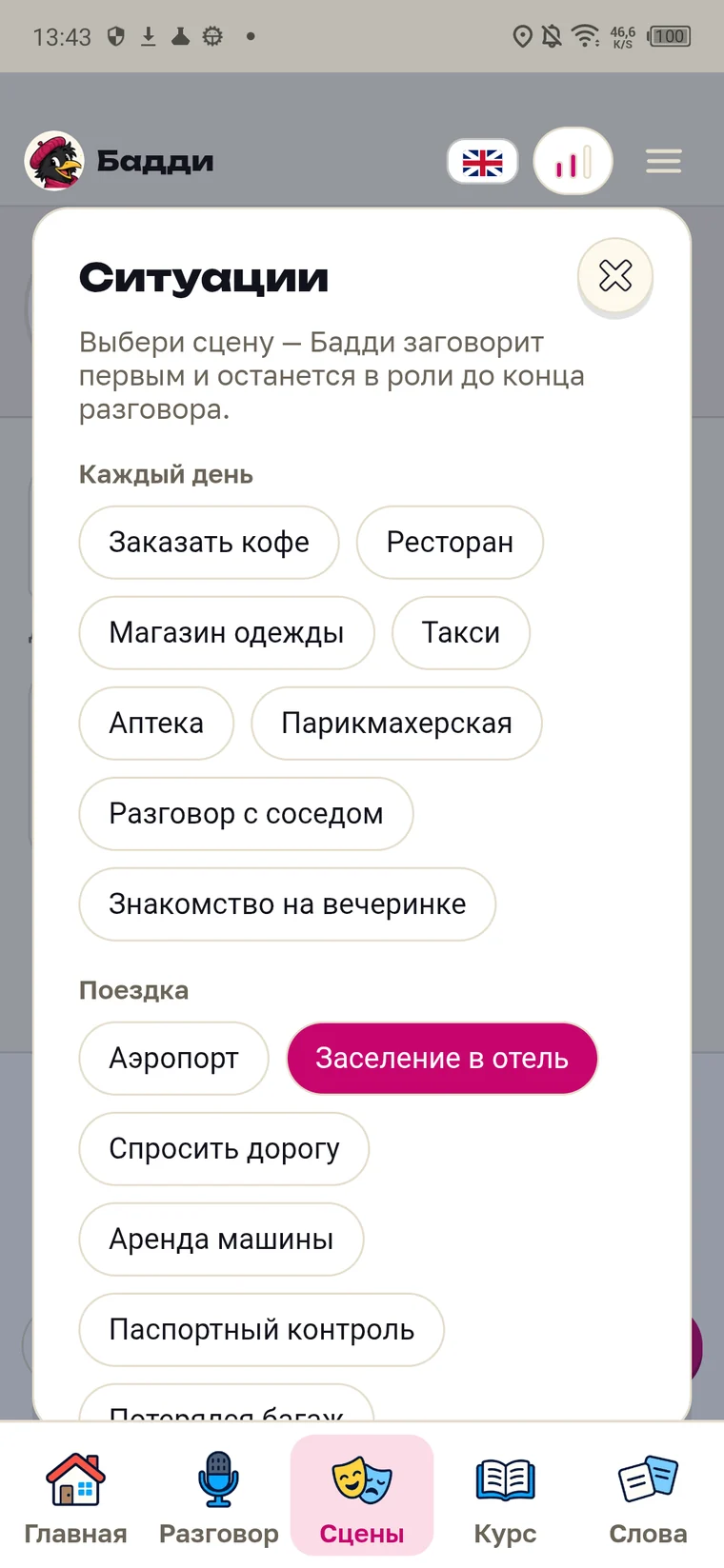
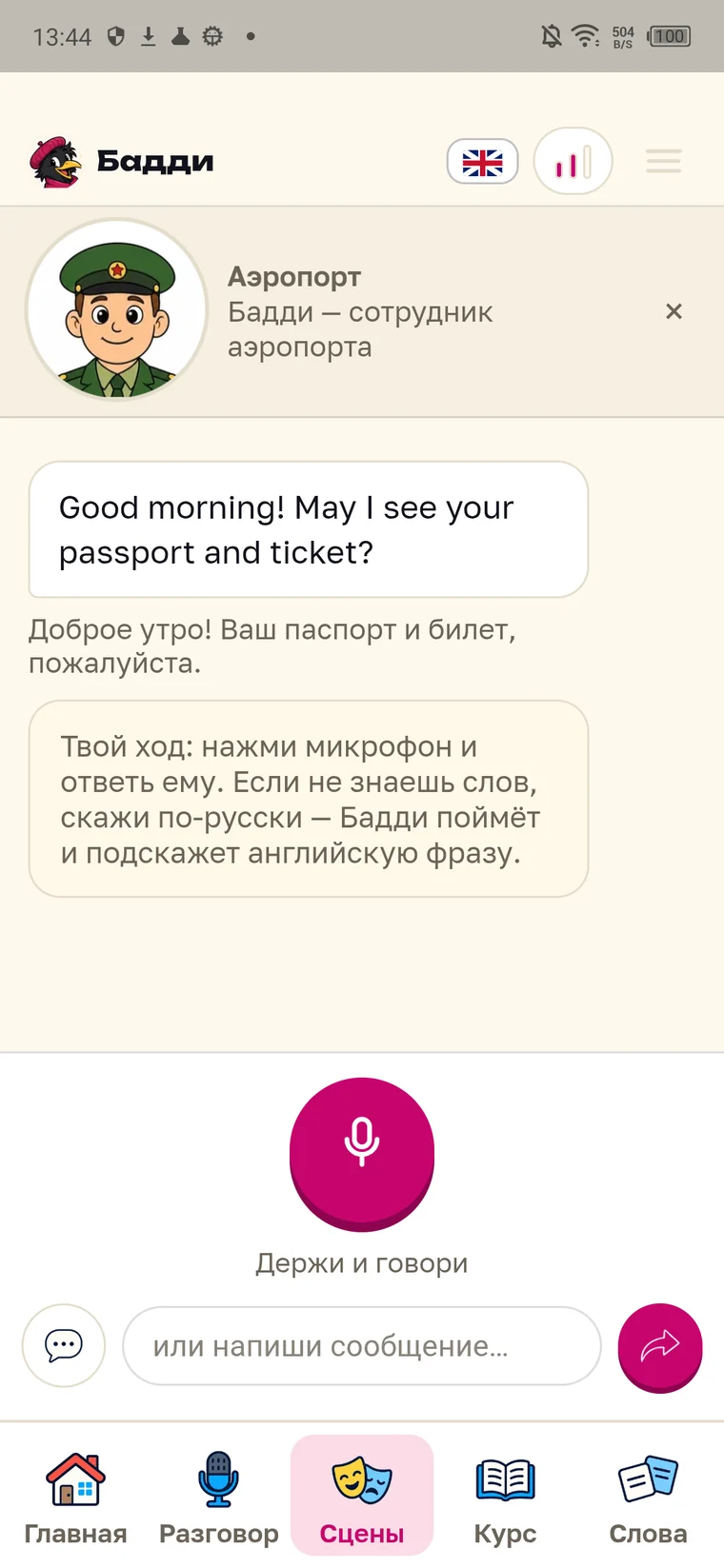
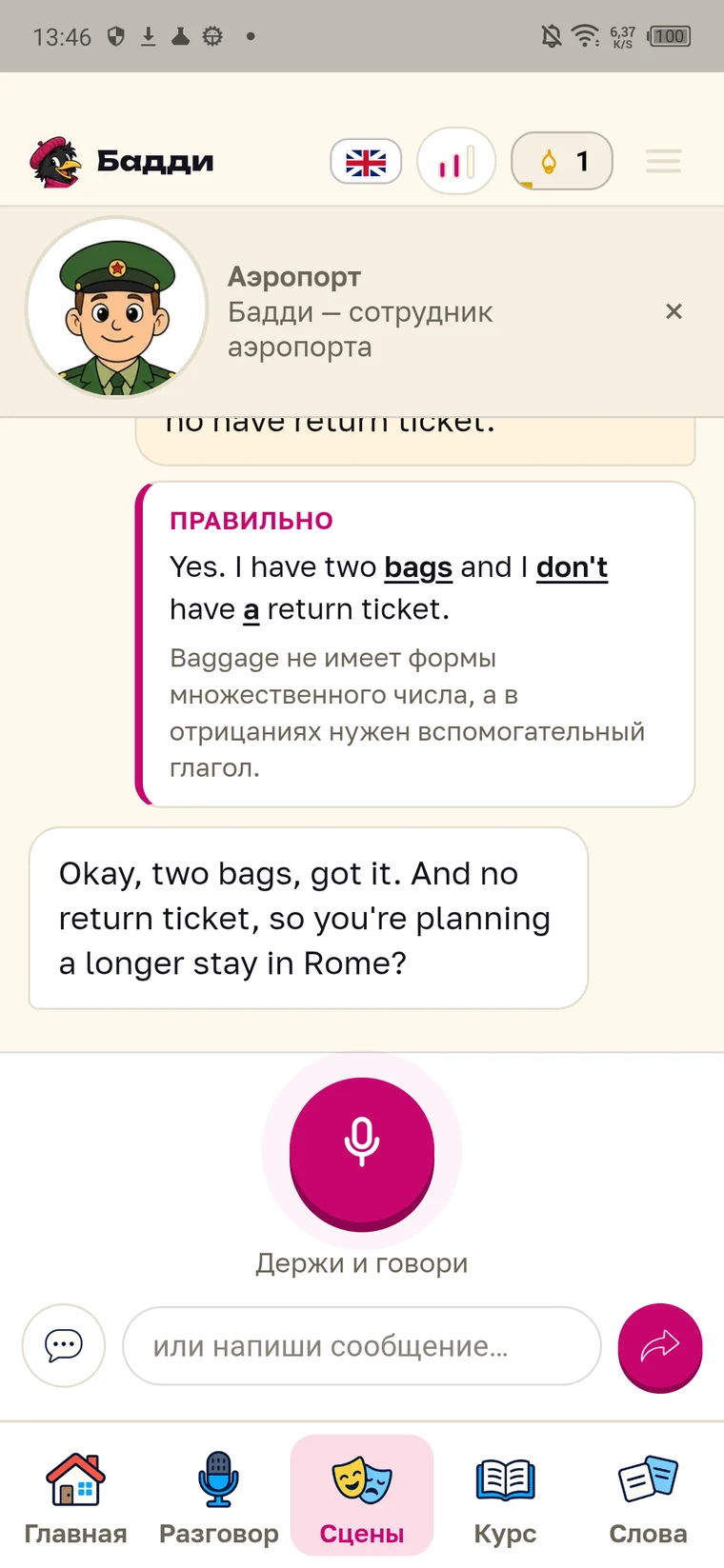
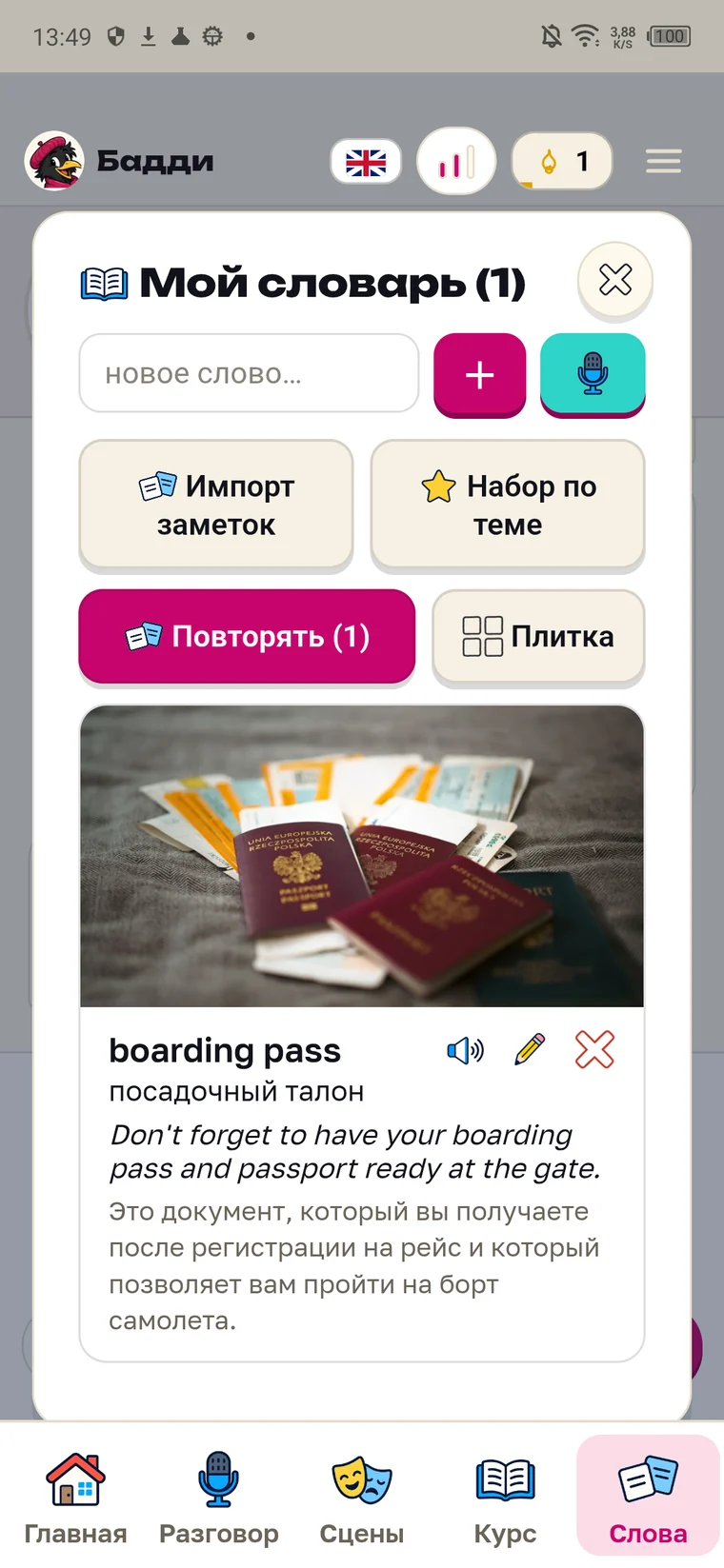
This is how that very seventh day from the plan happens, but every evening. We give five spoken answers per day for free, which is enough for one scene, and fifteen text answers.
What not to learn before a trip
There are twelve English tenses, but only two are used at the airport. No one will hear articles in the answer "Tourism." Spending the last week on grammar exercises is the most reliable way to arrive with a perfect present perfect and stand silently at passport control.
But twenty Q&A pairs, spoken aloud ten times each, do work. We have a separate article on how to stop translating in your head altogether: a separate analysis, and as for understanding other people's speech — English by ear.
Fifteen text answers every day and twenty voice replies to try – no card and no registration. You press the microphone and speak, Parleo answers with voice and shows mistakes.
Open Parleo